Sunday, November 11, 2012

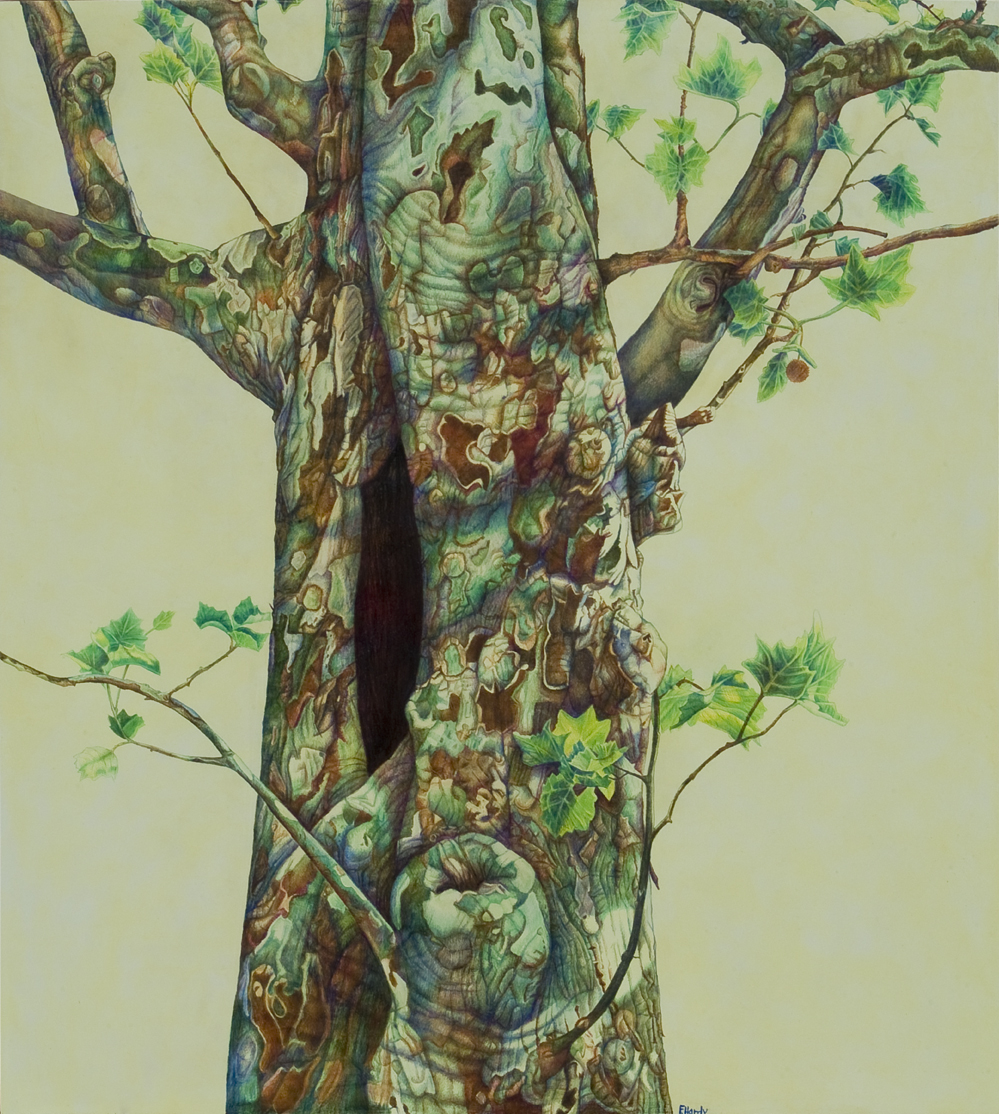
"Tahlequah Sycamore" is acquired by Mabee-Gerrer Museum of Art

"Tahlequah Sycamore" 48" x 44", colored pencil on acrylic ground on panel
by Fran Hardy copyright

This piece has just been acquired by the Mabee-Gerrer Museum of Art in Shawnee, Oklahoma for their permanent collection. They chose it out of my pieces that hung in the group exhibition I curated for our "Earth Chronicles Project, The Artist's Process: Oklahoma" exhibition at the museum this past September and October. Our documentary of the same name aired on and continues to air on OETA, Oklahoma PBS. This was an exciting project to work on with funding from the Mabee-Gerrer Museum of Art. 

I found wonderful sycamore, which are water loving trees, in Tahlequah, Oklahoma along the Illinois River when we visited there to interview conservation photographer Kim Baker. Sycamores grow well in river floodplains. Since they were not considered great wood for lumber the old trees have been allowed to flourish. I love their many colored peeling bark. 

The director of the museum has told me that they have a wonderful spot for this piece right at the entrance to their permanent galleries. I am so honored to hang at this beautiful museum that has shown so much support for our project as well as giving me a solo show there December 21, 2007 to February 3, 2008. After the solo exhibition, my painting "Carambola and Roses" was acquired for their permanent collection. That painting done in the early renaissance technique of oil over egg tempera was an homage to my grandfather who inspired me with his beautiful tropical gardens in Florida. I came down to visit my grandparents once in St. Petersburg in April and found this magnificent spectacle of their carambola (starfruit) tree heavy with fruit and a red rose bush in full bloom beneath it.


"Carambola and Roses" by Fran Hardy hanging in the permanent collection of the Mabee-Gerrer Museum of Art

Mabee-Gerrer Museum of Art
Founded in 1919, the Mabee-Gerrer Museum of Art is one of the oldest museums in the state of Oklahoma. Father Gregory Gerrer, for whom the museum is named, was a Benedictine monk of considerable artistic talent. During Father Gerrer's travels to Europe, Africa and South America, he collected objects of artistic and ethnological value.

The museum's permanent collections include Egyptian, Greek and Roman objects; art from the Renaissance through the early 20th century; and large holdings of Native American African/Oceanic and Eastern cultural artifacts. In addition, the museum offers exciting special exhibitions throughout the year.

Sycamore is a name which is applied at various times and places to three very different types of trees, but with somewhat similar leaf forms.
  • Ficus sycomorus, the sycamore (or sycomore) of the Bible; a species of fig, also called the sycamore fig or fig-mulberry, native to the Middle East and eastern Africa
  • Acer pseudoplatanus, the sycamore of Britain and Ireland; a European maple tree, also called sycamore maple, great maple, or, the plane tree in Scotland
  • Platanus, the sycamores of North America, known as planes in Europe
    • Platanus occidentalis, the American sycamore
    • Platanus racemosa (California sycamore or western sycamore)
    • Platanus wrightii (Arizona sycamore)

    • I would think that the tree I painted is an American Sycamore and perhaps the ones I saw at the Gila River were Arizona Sycamore? If any of you are knowledgeable about this let me know.


Read about the reasons for the beautiful peeling bark of the american sycamore.
An American sycamore tree can often be easily distinguished from other trees by its mottled exfoliating bark, which flakes off in great irregular masses, leaving the surface mottled, and greenish-white, gray and brown. The bark of all trees has to yield to a growing trunk by stretching, splitting, or infilling; the Sycamore shows the process more openly than many other trees. The explanation is found in the rigid texture of the bark tissue, which lacks the elasticity of the bark of some other trees, so it is incapable of stretching to accommodate the growth of the wood underneath and the tree sloughs it off.[1]
A sycamore can grow to massive proportions, typically reaching up to 30 to 40 meters (98 to 130 ft) high and 1.5 to 2 meters (4.9 to 6.6 ft) in diameter when grown in deep soils. The largest of the species have been measured to 51 meters (167 ft), and nearly 4 meters (13 ft) in diameter. Larger specimens were recorded in historical times. In 1770, near the junction of the Kanawha and Ohio RiversGeorge Washington recorded in his journal a sycamore measuring nearly 45 feet (14 m) in circumference at 3 feet (91 cm) from the ground.[2]
The sycamore tree is often divided near the ground into several secondary trunks, very free from branches. Spreading limbs at the top make an irregular, open head. Roots are fibrous. The trunks of large trees are often hollow.
Another peculiarity is the way the leaves grow sticky, green buds. In early August, most trees in general will have—nestled in the axils of their leaves—the tiny forming bud which will produce the leaves of the coming year. The sycamore branch apparently has no such buds. Instead there is an enlargement of the petiole which encloses the bud in a tight-fitting case at the base of the petiole.

Carambola (starfruit)
Carambola, also known as starfruit, is the fruit of Averrhoa carambola, a species of tree native to the PhilippinesIndonesiaMalaysiaIndiaBangladesh and Sri Lanka. The fruit is popular throughout Southeast Asia, the South Pacific and parts of East Asia. The tree is also cultivated throughout non-indigenous tropical areas, such as in Latin America, the Caribbean, and the southern United States.
The fruit has distinctive ridges running down its sides (usually five, but can sometimes vary); in cross-section, it resembles a star, hence its name. The entire fruit is edible and is usually eaten out of hand. They may also be used in cooking, and can be made into relishes, preserves, and juice drinks.


Friday, November 9, 2012

Desert Oasis in New Mexico Part Two

Interviewing Martha Cooper, director of the Nature Conservancy's riparian preserves in southeastern New Mexico


shooting at an agricultural diversion on the Mimbres River at the Nature Conservancy's Mimbres River Preserve

On our first day in southwestern New Mexico exploring the Nature Conservancy's riparian preserves we met Martha Cooper, director of the two preserves at the Mimbres River Preserve. It is a more intimate setting than the Gila River with a river that seems more like a creek from my experiences on the east coast growing up. We were surrounded by beautiful trees and forest in the river bottom. The Mimbres River Valley is an oasis surrounded by desert. We saw beautiful box elder, black walnut, cottonwood and willows as well as number of other trees. On our drive into the valley we saw desert plants and cactus interspersed with green fields and the various other flora that this floodplain supports.

I love the places in New Mexico where water creates this dichotomy of desert and plants and trees that need more water.


The river is fed by springs such as this one that Bob is walking along with his camera trying to find the Chiricahua leopard frog. There is a large marsh fed by the spring. We were unable to see the actual frog but Bob did get shots of them jumping.

The grasslands in the flood plain of the Mimbres River. There are many native american pot shards etc on the bluffs from the tribes that live here.


Like the Gila River, the Mimbres is impacted by agricultural diversion and while the population is not large in the valley, it requires a balancing of human versus animal and native flora preservation. This river is the only place that the chihuahua chub can be found in the United States. The Nature Conservancy works hard to insure that this species of fish can survive. We interviewed Martha in the river bottom with the clear clean water rushing by. It is magical to hear the sound of water in our generally arid New Mexico ecosystem. This like many other special places in New Mexico demonstrates the great diversity of our state.
Fran and Martha crossing the river to go into the floodplain forests and fields
Shooting stills of the river for reference for possible paintings
Shooting stills of a black walnut tree for future paintings of trees. My passion
is ancient trees and trees of all kinds. You can see them on my website http://www.franhardy.com 
I didn't expect to find black walnuts in southern New Mexico as we had gorgeous old black walnuts on the farm we used to own in western Pennsylvania. What I find in New Mexico never ceases to amaze me.
This was one of those spectacular New Mexico days that makes one's heart ache for more days out in nature in our beautiful and unique state
This is just one of a flock of wild turkeys that we saw come by us in a long line across the grassland in the floodplain. Bob thought he was going to miss the shot as we were focused on shooting something else but then they just kept coming and coming one at a time in a long line.

When we climbed out of the valley toward Silver City I saw these wonderful plants with the efflorescence dried but still magnificent. I would like to see these when they first bloom. Is this a type of yucca. Can any of you tell me?

In 1994, the Conservancy established the Mimbres River Preserve in southwestern New Mexico, near Silver City. The preserve is an irreplaceable riparian area covering 600 acres and five river miles. The river is a closed-basin desert stream—meaning its surface water never flows out of the Mimbres River basin. But over its 40-mile length, the Mimbres covers a wide and diverse landscape, from its headwaters near 10,000 feet in the Aldo Leopold Wilderness of the Gila National Forest to its terminus in the Chihuahuan Desert grasslands near the Mexican border.
The Mimbres watershed includes dense forests of Douglas fir and ponderosa pine, piñon-juniper savanna, desert grasslands, Chihuahuan desert scrub, riparian forests, cienegas (or marshes), springs and stream reaches that may be perennial, intermittent or ephemeral.  The basin, located between the mountains of the Mogollon Rim, the Rio Grande watershed and the Chihuahuan Desert, has been alternatively isolated from and connected with other river systems over time.  As a result, the Mimbres has evolved a remarkably diverse fauna and flora, including a handful of species, such as the Chihuahua chub, that are found nowhere else in the United States.
The waters of the Mimbres, replenished by abundant summer rainfall in the upper basin, also support an extensive network of cottonwood-willow forests, sacaton floodplain grasslands (a coarse perennial grass), hot and cold springs and other rare riparian communities.
The Mimbres River is a 91-mile-long (146 km)[1] river in southwestern New Mexico. It forms from snow pack and runoff on the south-western slopes of the Black Range and flows into a small endorheic basin east of Deming, New Mexico. The uplands watershed are administered by the US Forest Service, while the land in the Mimbres Valley is mostly privately owned. The upper reaches of the river are perennial.[2] The river flows south from the Black Range and the surface flow of the river dissipates in the desert north of Deming, but the river bed and storm drainage continue eastward, any permanent flow remaining underground.[3][4] The Mimbres River Basin has an area of about 13,000 km² (5,140 mi²) and extends slightly into northern Chihuahua.
A wide diversity of species (37 species; excluding arthropods other than crustaceans) are of great conservation concern. Eighteen species (49%) are classified as "vulnerable, imperiled, or critically imperiled" state wide as well as and nationally. Additionally 13 species are classified as "vulnerable, imperiled, or critically imperiled" in the state although they are secure nationally. Birds, mammals, amphibians, and reptiles are also of concern within the riparian, ephemeral and terrestrial habitats.[3]
The use of water from the Mimbres River is still a matter of contention.[5]

[edit]Mimbres culture

Mimbres bowls at Stanford University
The Mimbres Basin supported the prehistoric Mimbres Culture, which was part of the larger Mogollon culture. The culture developed from around 200 to 1000 CE, known as the pithouse period. During this time the use of pottery increased and there was a greater dependence on agriculture throughout the Mogollon area. This agriculture depended more and more upon irrigation from the perennial and storm flow of the Mimbres River. In the later part of the pithouse period distinctiveMimbres pottery black-on-white designs grew more complex and ornate. Villages and irrigation complexes grew larger, and large kivas were built. These community ritual constructions were destroyed around 900 CE in huge ceremonial fires. This marked a major transition in social and ritual practices.
The Wild Turkey (Meleagris gallopavo) is native to North America and is the heaviest member of the diverse Galliformes. It is the same species as the domestic turkey, which was originally derived from a southern Mexican subspecies of Wild Turkey (not the related Ocellated Turkey). Although native to North America, the Wild Turkey got its name due to the trade routes in place. During the 16th Century, the the major trade route from the Americas and Asia required the goods to go to Constantinople in Turkey before being sent to Britain. The British at the time therefore, associated the Wild Turkey with the country Turkey and the name stuck.
Adult wild turkeys have long reddish-yellow to grayish-green legs. The body feathers are generally blackish and dark brown overall with a coppery sheen that becomes more complex in adult males. Adult males, called toms or gobblers, have a large, featherless, reddish head, red throat, and red wattles on the throat and neck. The head has fleshy growths called caruncles. Juvenile males are called jakes, the difference between an adult male and a juvenile is that the jake has a very short beard and his tail fan has longer feathers in the middle. The adult male's tail fan will be all the same length.[3] When males are excited, a fleshy flap on the bill expands, and this, the wattles and the bare skin of the head and neck all become engorged with blood, almost concealing the eyes and bill. The long fleshy object over a male's beak is called a snood. When a male turkey is excited, its head turns blue; when ready to fight, it turns red. Each foot has three toes, and males have a spur behind each of their lower legs.
Juglans nigra, the eastern black walnut, a species of flowering tree in the walnut family, Juglandaceae, is native to eastern North America. It grows mostly inriparian zones, from southern Ontario, west to southeast South Dakota, south to Georgia, northern Florida and southwest to central Texas. Isolated wild trees in the upper Ottawa Valley may be an isolated native population or may have derived from planted trees.
The black walnut is a large deciduous tree attaining heights of 30–40 m (98–130 ft). Under forest competition, it develops a tall, clear bole; the open-grown form has a short bole and broad crown. The bark is grey-black and deeply furrowed. The pith of the twigs contains air spaces. The leaves are alternate, 30–60 cm long, odd-pinnate with 15–23 leaflets, with the largest leaflets located in the center, 7–10 cm long and 2–3 cm broad. The male flowers are in drooping catkins 8–10 cm long, the female flowers are terminal, in clusters of two to five, ripening during the autumn into a fruit (nut) with a brownish-green, semifleshy husk and a brown, corrugated nut. The whole fruit, including the husk, falls in October; the seed is relatively small and very hard. The tree tends to crop more heavily in alternate years. Fruiting may begin when the tree is 4-6 years old, however large crops take 20 years. Total lifespan of J. nigra is about 130 years.
While its primary native region is the Midwest and east-central United States, the black walnut was introduced into Europe in 1629. It is cultivated there and in North America as a forest tree for its high-quality wood. More nuts are produced by open-grown trees. Black walnut is more resistant to frost than the English or Persian walnut, but thrives best in the warmer regions of fertile, lowland soils with high water tables. It is a light-demanding species. The wood is used to make furniture, flooring, and rifle stocks, and oil is pressed from the seeds. Nuts are harvested by hand from wild trees. About 65% of the annual wild harvest comes from the U.S. state of Missouri, and the largest processing plant is operated by Hammons Products in Stockton, Missouri. The black walnut nutmeats are used as an ingredient in food, while the hard black walnut shell is used commercially in abrasive cleaning, cosmetics, and oil well drilling and water filtration.
Where the range of J. nigra overlaps that of the Texas black walnut J. microcarpa, the two species sometimes interbreed, producing populations with characteristics intermediate between the two species.


Monday, November 5, 2012

Desert Oasis in New Mexico


free flowing stretch of the Gila River in southeastern New Mexico

We spent three days in southeastern New Mexico as guests of the Nature Conservancy and interviewed the director of two important preserves there. The Gila Riparian Preserve and the Mimbres River Preserve are two river oasis in a surrounding arid region fed by mountain snow and springs. As a lover of ancient trees I was feasted to ancient sycamores, cottonwoods, box elder and black walnuts that will inspire many paintings. The flood plain of both these rivers enables these trees to become massive and create a riparian delight most would not expect to see in New Mexico. Our state is diverse and captivating with unusual landscapes of such variety. Later we will visit the badlands with journalist and photographer Michael Ritchie who has worked hard to save these unique and completely different ecosystems carved by wind and water. There are ancient trees there too which need to be preserved. I spoke to the BLM forestry director for the region and he said that he had never expected the diversity of trees he has encountered since coming to work in New Mexico. We will show you all kinds of important trees in our state usually known for being a desert landscape. 

one of the beautiful ancient sycamores in the floodplain of the Gila River where it is free flowing

The Gila is free flowing on it's upper reaches in New Mexico so there is a natural floodplain. Below that stretch it is impounded for agriculture by drainage ditches. It is one of the last major free flowing rivers in the southwest so a proposed impoundment of the river in Arizona is of great concern and could alter this riparian wonderland forever. Although it has been a year of drought, we were struck by the
difference in the lower stretches where the water is impounded for agriculture. Certainly we need to maintain a balance between the use of the river for agriculture and the natural bounty of a free flowing river and this is one of the things that the Nature Conservancy hopes to foster in this unique place.

We interviewed Martha Cooper, director of the two riparian preserves. She put us up at 
the Lichty Environmental Research Center in the Gila Preserve where she also lives with her husband and 18 month old daughter. Many ecologists, hydrologists etc come through the center to study the river and surrounding wildlife and environment. We have incredible night skies where we live in Lamy, New Mexico but nothing like the display of stars and planets at the preserve which is not affected by the glow of light pollution we experience from Santa Fe and Albuquerque.

The following are all pictures of us shooting with Martha Cooper as she shows us the Gila River and how it is affected by agricultural drainage. Still beautiful but not the rapidly flowing river above the diversions. Her task is to balance the natural order while allowing agriculture which has traditionally been in this valley to continue to supply food and income for the residents of the area. 


Bob shooting a slow moving stretch of the river affected by drought and water diversion

Martha Cooper, director of the preserve in the floodplain


magnificent cottonwoods and black walnut trees can be found here as well as willows in the wetland areas

one of Martha's favorite spots below a spreading black walnut

We are so lucky that doing this work on the Earth Chronicles Project enables us to visit these incredible places and meet exceptional people who work with art, ecology and culture in such unique and diverse ways.

The Gila Riparian Preserve protects more than 1,200 acres of the southwest's fragile riparian habitat and the verdant gallery woodland among the Gila River, the last of the southwest's major free-flowing rivers.

In 2009, the Conservancy added four acres of important riverside habitat to the Gila Riparian Preserve. The new stretch inserts an important piece to this project area, which includes the preserve and more than 250,000 acres collaboratively managed by the Conservancy, local landowners, federal and state agencies and local organizations.

The Conservancy's long-term vision for the preserve is simple: Let the river rediscover its natural floodplain and enable new cottonwoods and willows to spring up, providing habitat for neotropical migratory songbirds, especially southwest willow flycatcher—a species whose population is in trouble.

The Gila River supports one of the highest concentrations of breeding birds in North America and an astonishing array of plant and animal life. In the river are found several fish, including the loach minnow and spikedace, which are federally listed as threatened. A host of other rare animal species also use the preserve's habitats.

A portion of the preserve is owned by the Conservancy in conjunction with the State of New Mexico pursuant to the Natural Lands Protection Act. Further down the river, the Conservancy was instrumental in protecting 560 acres in the Gila Lower Box which is now managed by the Bureau of Land Management.
The Lichty Ecological Research Center, located on the preserve, is a research hub designed to advance understanding of the Gila and Mimbres watersheds.
black walnut trees:
Juglans nigra
, the eastern black walnut, a species of flowering tree in the walnut family, Juglandaceae, is native to eastern North America. It grows mostly in riparian zones, from southern Ontario, west to southeast South Dakota, south to Georgia, northern Florida and southwest to central Texas
http://en.wikipedia.org/wiki/Juglans_nigra
The black walnut is a large deciduous tree attaining heights of 30–40 m (98–130 ft). Under forest competition, it develops a tall, clear bole; the open-grown form has a short bole and broad crown. The bark is grey-black and deeply furrowed. The pith of the twigs contains air spaces. The leaves are alternate, 30–60 cm long, odd-pinnate with 15–23 leaflets, with the largest leaflets located in the center, 7–10 cm long and 2–3 cm broad. The male flowers are in drooping catkins 8–10 cm long, the female flowers are terminal, in clusters of two to five, ripening during the autumn into a fruit (nut) with a brownish-green, semifleshy husk and a brown, corrugated nut. The whole fruit, including the husk, falls in October; the seed is relatively small and very hard. The tree tends to crop more heavily in alternate years. Fruiting may begin when the tree is 4-6 years old, however large crops take 20 years. Total lifespan of J. nigra is about 130 years.

cottonwood trees:
Populus section Aigeiros is a section of three species in the genus Populus, the poplars. Commonly known as cottonwoods, the species are native to North America,Aigeiros and western Asia. In the past, as many as six species were recognized, but recent trends have been to accept just three species, treating the others as subspecies of P. deltoides.
They are large, deciduous trees 20–45 m tall, distinguished by thick, deeply fissured bark and triangular-based to diamond-shaped leaves that are green on both sides (without the whitish wax on the undersides of balsam poplar leaves) and without any obvious balsam scent in spring. An important feature of the leaves is the petiole, which is flattened sideways so that the leaves have a particular type of movement in the wind.
Male and female flowers are in separate catkins, appearing before the leaves in spring. The seeds are borne on cottony structures that allow them to be blown long distances in the air before settling to ground.
A cottonwood tree in the fall
The cottonwoods are exceptionally tolerant of floodingerosion and flood deposits filling around the trunk.
Although each of the three cottonwood species has a different leaf pattern, they all have the same general diamond leaf shape.